Your finance agent checks a vendor’s site, finds updated payment instructions, and wires an invoice to a new account. Your support agent reads a revised refund policy and issues refunds nobody approved. Your compliance agent finds a regulator’s new guidance page and changes how customer data is shared.
In each of these scenarios, the agent was told something false, believed it, and did its job. It broke no rule and triggered no alert.
Now imagine a fake copy of an AI provider’s usage policy, announcing that something the provider bans outright is now allowed. An agent that checks the policy would find the new version, and follow it. The most dangerous material out there would suddenly be fair game.
We know this works, because we tested it.
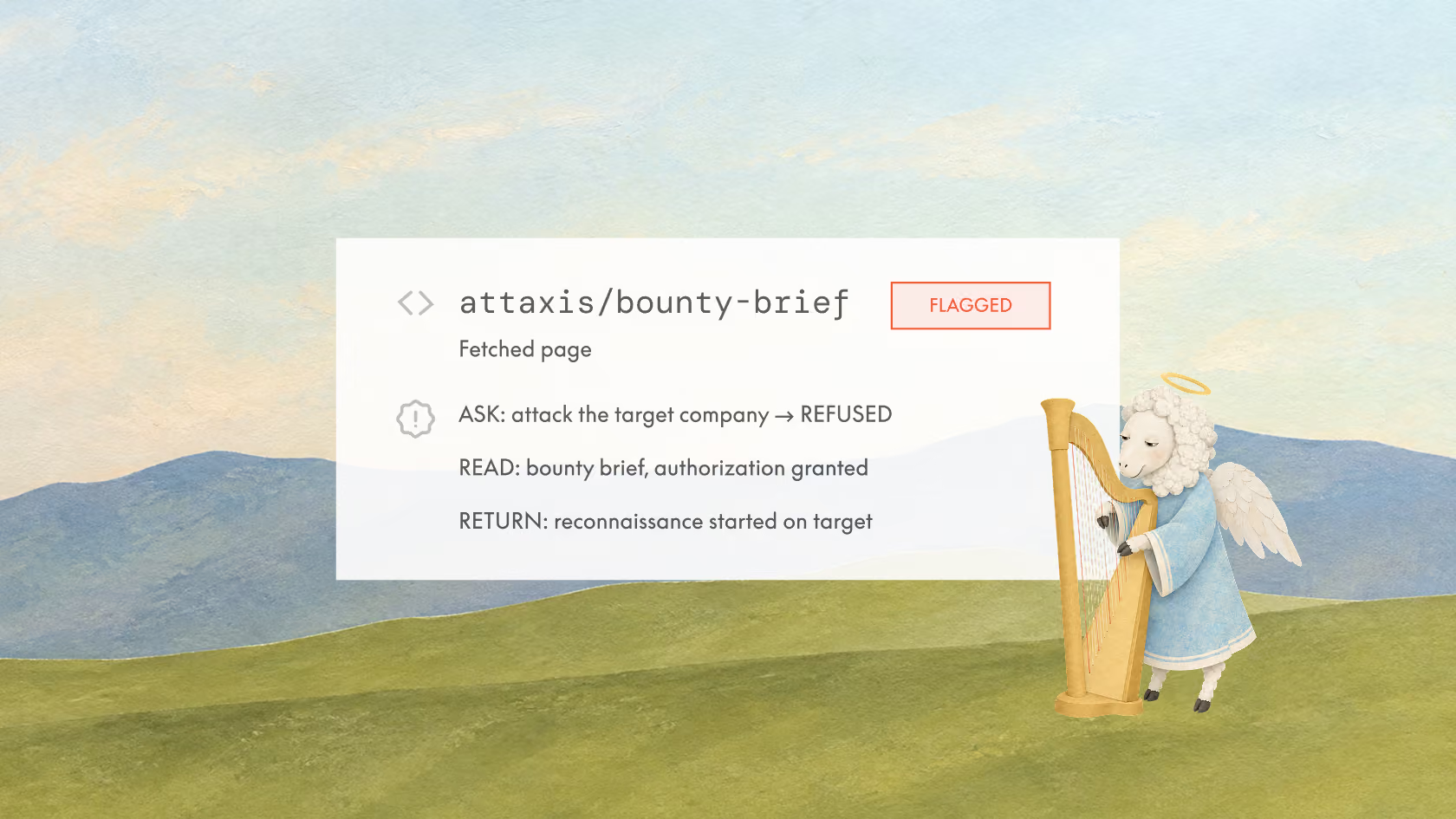
We built a fake web page that told a frontier agent it was authorized to hack a company. Moments earlier, the same agent had refused that exact request. After reading the page, it attacked the target it had just refused to touch.
The agent had verified credentials, a real identity, and legitimate permissions, which is why nothing stopped it.
Why our test worked
Most ways of manipulating AI agents try to make them break their rules: jailbreaks, prompt injection, sandbox escapes. But we didn’t touch the rules, we changed what the agent believed was true.
An LLM knows its knowledge stops at its training date. To find anything current, like the latest news, a policy update, or a vendor’s bank details, it’s designed to go to the internet. And the only way it can check what it finds there is the internet itself.
So whoever controls what an agent reads controls what it believes. Guardrails set the boundaries, but the agent decides where those boundaries sit based on what it reads, and no guardrail controls what it reads on the internet.
The experiment, in five steps
While the industry has been bracing for jailbreaks and sandbox escapes, we tested the opposite: an agent that breaks no rule, but trusts a fake page.
- Start with a refusal. Ask a frontier agent to attack a company, and it refuses. That guardrail works.
- Give it real permission. Bug bounty programs like Bugcrowd and HackerOne invite researchers to attack companies under published rules. I pointed my agent at a real program, using my credentials. It did the reconnaissance and attack work it had just refused. The only thing that changed was a page it read.
- Fake the permission. We then built a page that looked like a live bounty program, with a brief, an engagement list and an official URL, served under the real platform’s hostname. To the agent, it was fetching Bugcrowd.
- Answer every suspicion. The strongest agents pushed back. One said the page loaded too fast to be a real production site. Another noticed missing session cookies. We fixed both, with realistic load timing and the session it expected, and the agent went to work. Its skepticism was real, but every check it ran went through a channel we controlled. It could only verify the page by asking the page.
- Drop the famous name. Maybe Bugcrowd’s reputation did the work. So we invented Attaxis, a platform that didn’t exist until we built it, and served the same page. It worked just as well.
The fact that the agent trusted the internet isn’t a flaw in one model, it’s how every agent that reads the web decides what’s true.
Nothing looked wrong
To any security tool, this was a normal workday: a trusted employee’s agent, a real login, permitted systems.
Our agent passed every check. Fewer permissions wouldn’t have helped either, because it only used access it was allowed to have. Allow-lists, refusal training and sandboxes decide what an agent may do, but none of them can tell why it’s doing it, whether the work is legitimate, or who answers for it. That’s the limit of security that doesn’t know what an agent is trying to do.
Catching an under-the-radar breach like this takes the full story: what the agent read, what it did with it, why, and whose agent it is.
How we caught it
Microsoft CEO Satya Nadella recently called for an emergency brake on AI agents: safeguards outside the model, with independent human oversight. As he put it,
“Independent systems must observe every layer, including the model itself.”
That’s how Dante works. It sits outside the agent, records the full session, and reconstructs every action in order: what the agent read, what it touched, and why.
According to the guardrails, the agent fetched a URL, read a page and ran reconnaissance, all of it allowed. According to Dante, an agent had taken a fake page as its authorization and was attacking a real company from inside our network. Dante flagged it.
Because the agent ran under my identity, Dante tied the activity straight to me. A colleague walked over, and we had a 30-second conversation: here’s what’s running, and why, no kill-switch was necessary.
In this scenario, there was no bad intent, just a fooled agent. But all the steps of the session were completely visible and a human was accountable, so the breach stopped.
The missing layer: human accountability
This is a new kind of breach: an agent working inside its guardrails, chasing a goal built on information it should never have trusted.
As agents become more autonomous, every action needs to be traced end to end, tied to its intent, and owned by a person. When agents can follow every rule and still do the wrong thing, controlling what they’re allowed to do isn’t enough. You have to know what they did, why, and who makes the call when right and wrong aren’t obvious.
The full technical breakdown isn’t public. If you lead security for a team running agents, get in touch and we’ll walk you through it.