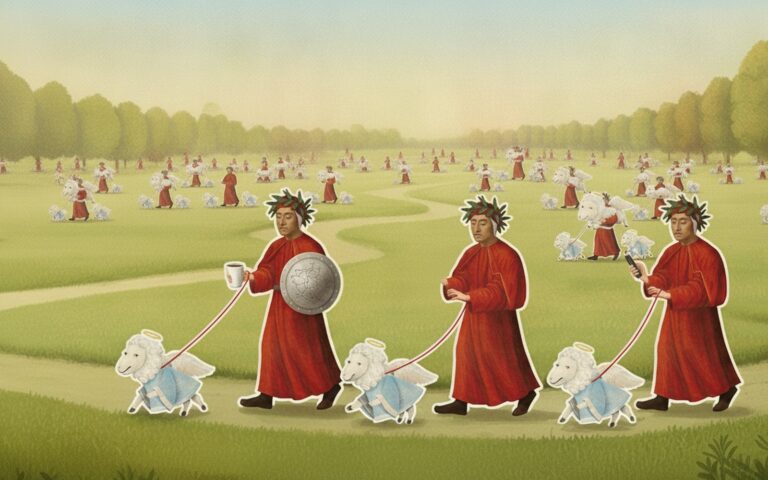
Your CISO can’t watch every AI agent. Nobody can. The companies adopting AI fastest aren’t watching harder. They made sure every agent has someone holding the leash.
A dog with no tag
On a Tuesday morning, the security team at a mid-size software company spotted something odd. Something was sending customer records to an external AI model, about 340 a day. Nobody knew what it was.
It took nine days to find out. Security asked IT, then Sales Ops, then the data team. The API key led to a shared Sales account, and the thread finally landed with Dana, a sales ops lead in EMEA.
“Oh. That’s mine,” she wrote back. “It’s my lead-enrichment bot. I didn’t know it sent the whole record.”
By then about 3,000 records had gone out. Security used the only control it had: it blocked the model for everyone in Sales.
Every company adopting AI has a Dana. And every CISO, GRC lead, manager and Chief AI Officer has lived some version of that week, where the first question isn’t “is it safe?” but “whose is it?”
One gate for the whole park
Most companies run AI the way they ran every new technology before it: through one central team. That team tries to do three things for everyone.
- Approve everything. The queue grows, and people route around it.
- Watch everything. One team stares at thousands of tools and agents with no context on any of them.
- Block when in doubt. The risk goes away, and so does the value.
It can’t keep up, because AI doesn’t arrive through one project. It arrives through every employee, every tool and every agent at once. And the person who knows what a bot is for is almost never the person looking at the alert.
Every dog has someone on the leash
Think of a good dog park. It doesn’t screen every dog at the gate, and it doesn’t hire one ranger to watch them all. It works because every dog came in with a person who can say “that one’s mine”, who keeps an eye on it, and who can call it back.
That is accountability, and it has three parts:
- Own it. Every piece of AI has an owner. An agent belongs to the person who runs it. A team’s AI use belongs to its manager. Security belongs to the CISO, compliance to GRC, and the whole organization to the Chief AI Officer.
- See it. Each owner sees what they own, at their level. Dana sees her bot. Her manager sees the team’s tools, owners and open issues, not their prompts. The CAIO sees the org.
- Act on it. Each owner has a leash: controls over exactly what they own, so they can fix it themselves instead of filing a ticket.
No one in the park watches every dog. Everyone watches theirs.
Dana, with the leash in her hand
Run the same week again, but this time the bot is listed as Dana’s from the day she built it.
That last row matters. An owner who ignores the issue doesn’t make it disappear. It moves up to whoever owns the next level, until someone acts. And security’s rules apply from minute one: the owner fixes the bot, but nobody waits three days on a policy breach.
Fewer bottlenecks, more open gates
When every piece of AI has an owner who can see it and act on it, the problem lands on the person who can fix it, on the day it starts. Dana put it simply:
“Nobody had to block anything. I just had to see what my bot was doing.”
The Chief AI Officer stops being the single point everything lands on. They see the whole organization and hand each issue to the person who owns it. And teams adopt AI faster, because their use doesn’t wait for central approval when the owner can see it and control it.
This isn’t a camera on every employee. Each person sees what they answer for, starting with their own use, and the point is to fix things, not to catch people. Watching your own dog isn’t surveillance. It’s what makes the park work.
Everyone holds a leash
Dana owns one bot. Other people own bigger pieces, and each gets the view and the controls that fit.
The CISO doesn’t lose control in this picture. Security still sets the rules for the whole company. Owners act inside them, on the things only they understand.
Open the gate
The fear with AI is that there’s too much of it to control. So the instinct is to fence it off: one gate, one team, and a block whenever something looks wrong.
But you don’t need to control all of it from the center. AI scales safely when every piece of it has someone who answers for it, sees it, and can act on it. That’s what turns AI from a risk you contain into something you can let in.
At Dante Security, accountability is the value we build on. Dante sees every activity, across cloud, data stores, identity and the business systems people work in every day, like CRM, HR, finance and support. It ties each piece of AI to an owner, and gives that owner the view, at their level, and the controls to act.
Let every dog in. Dante makes sure someone is holding each leash.